ChatGPT Ads vs Google Ads: Recommendation Surfaces Are Opening, but Control and Measurement Still Belong to Google
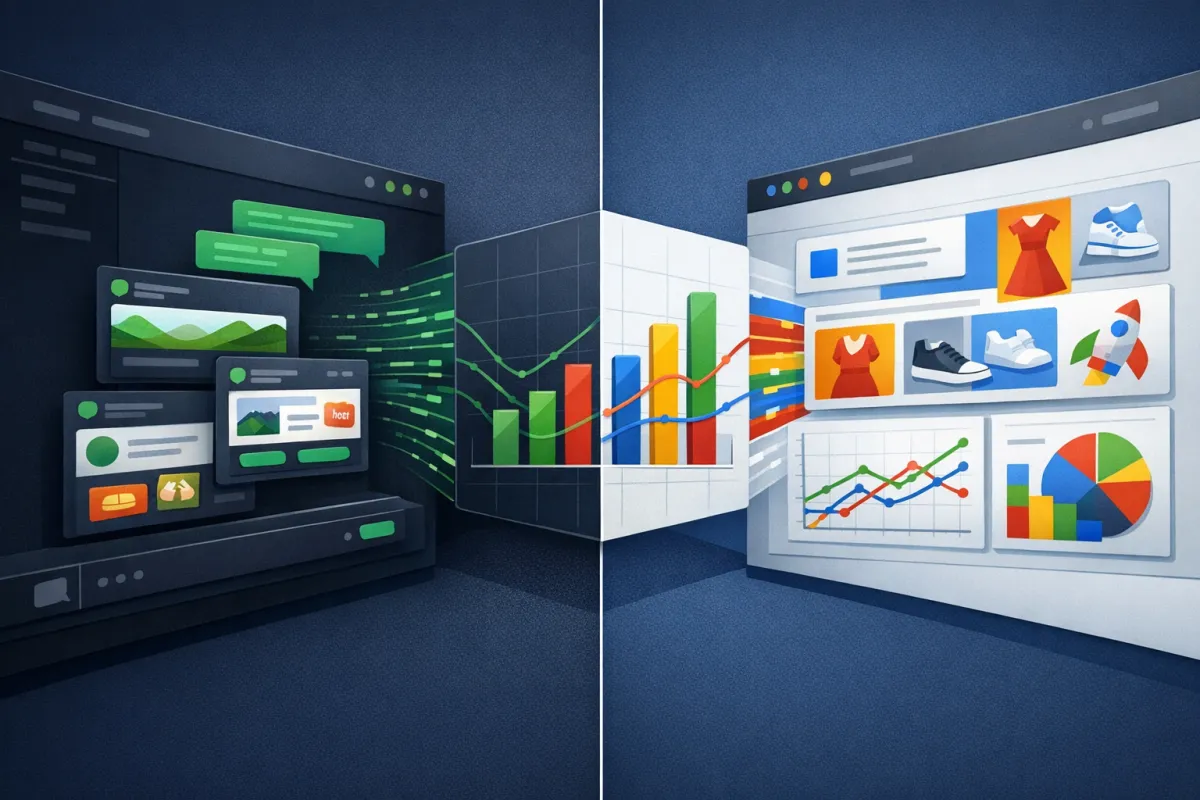
ChatGPT ads are getting more real. Google Ads still matters more.
That is the cleanest way to frame the comparison right now.
OpenAI’s ad business has crossed an important threshold. The company is openly testing ads in ChatGPT, has a public advertiser sign-up page, and has started moving its pilot from direct handling toward an early ads manager workflow. According to PPC Land, citing Digiday and early buyer feedback, that shift includes lowering the participation threshold to roughly $50,000 and giving a subset of advertisers direct access to impressions and clicks reporting. That is not a side experiment anymore. It is the beginning of a media system.
But the buying decision still looks lopsided when compared with Google.
Google already owns the default search distribution layer, the commerce-intent layer, and the campaign infrastructure that most advertisers use every day. Its AI Overviews ad eligibility is already wired into existing Search, Shopping, Performance Max, App, and local ad systems. In practical terms, that means Google can put ads above, below, or within AI Overviews at massive scale before most buyers even finish arguing about whether conversational media is real.
So the comparison is not “new thing versus dead thing.” It is recommendation-native context versus reach, control, and measurement maturity.
That difference matters for marketers because the market is at risk of oversimplifying both channels. ChatGPT ads are not just a smaller Google clone. Google Ads is not just a legacy keyword machine. They are converging toward a world where recommendations and sponsored actions appear inside machine-mediated journeys, but they are doing so from very different starting points.
For the commercial service layer, the closest live Searchless destination is Ads. For the category definition, the live glossary support page is ChatGPT advertising. For the structured comparison destination, the live target is ChatGPT ads vs Google Ads. For the broader market frame, Searchless also maintains AI search statistics.
What OpenAI has actually changed
One of the mistakes in this market is discussing ChatGPT ads as if they are still theoretical.
They are not.
OpenAI’s own advertising pages already spell out the direction. The company says people use ChatGPT to ask questions, compare options, and decide what to do next, and that it is exploring advertising as a way for businesses to connect with people when they are researching and ready to act. Its testing announcement adds more detail. Ads are live in the U.S. for logged-in adult users on Free and Go tiers, with paid business-oriented tiers excluded. OpenAI says ads do not influence answers, advertisers do not get chat data, and ad matching uses conversation topic, past chats, and prior ad interactions.
That is a meaningful operating model.
It tells us three things.
First, ChatGPT ads are being positioned around conversational intent, not classic search-query capture.
Second, OpenAI is trying to preserve trust by separating ads from the organic answer system and limiting advertiser influence.
Third, the product is early enough that the company is still choosing how much precision, transparency, and scale it is willing to offer.
That last point is why the recent ads-manager reporting matters. PPC Land’s account of the early tool suggests a familiar campaign hierarchy, simple ad formats, context hints rather than elaborate audience structures, and direct reporting for impressions and clicks. In other words, the system is beginning to look buyable by working media teams rather than only through bespoke pilot conversations.
That is progress.
But it is still narrow progress.
What Google already controls
Google starts from the opposite position.
It does not need to prove that advertisers will buy. It needs to decide how aggressively to reroute existing ad demand into AI-mediated search experiences.
Google’s own Ads Help documentation is blunt. Ads are eligible to show above, below, or within AI Overviews. Existing text, shopping, local, app, Search, Shopping, and Performance Max campaigns can all become eligible across the markets where AI Overviews are available. That is not a limited philosophical statement. It is industrial distribution.
This is why AdExchanger’s framing is so important. Google is the only platform that has truly “flipped the switch” with AI-search advertising at scale. Even if the reporting is imperfect, the inventory access is real.
That creates a practical asymmetry.
ChatGPT ads are exciting because they are native to conversational intent.
Google AI Overviews ads matter because Google already owns the habit layer, the shopping layer, and the advertiser infrastructure.
If a buyer wants guaranteed scale today, Google still has the stronger answer.
The real difference is where the ad sits in the journey
This is where marketers should stop comparing the channels too lazily.
Google Ads mostly grew up in an environment where the query was the starting unit of intent. Even when campaigns became more automated and AI-mediated, the system still inherited a search-and-click architecture. Ads compete around query matching, placements, inventory, and conversion optimization inside a network the buyer already knows.
ChatGPT ads are being built for something more fluid. The user may begin with exploration, ask for comparisons, refine a need, and move toward a decision inside a continuous conversation. That means the ad opportunity sits closer to interpreted intent than explicit keyword syntax.
In theory, that is powerful.
If a system understands the evolving problem a user is solving, an advertiser can intervene at a more contextual moment than a classic keyword match allows.
In practice, the system is still constrained.
OpenAI’s early ad formats are simple. Context hints are not yet the same as robust targeting. Reach is narrower. Measurement is earlier. The tool is closer to first-generation infrastructure than to a mature media platform.
Google, by contrast, may be less elegant conceptually, but it has scale, automation, creative systems, broad inventory, and an army of buyers who already know how to spend there.
That is why the right comparison is not philosophical. It is operational.
Control and transparency remain a messy tradeoff
The irony in the current market is that Google has greater reach but not necessarily greater transparency on AI-specific placements, while ChatGPT has smaller scale but more intense scrutiny from early buyers.
AdExchanger captures this tension well. A Google Search or Performance Max advertiser may be eligible for AI Overviews placements without gaining a clean read on when and how those impressions were served, or how they contributed. Google is operating the bigger machine, but not necessarily giving buyers a clear AI-specific dashboard for it.
ChatGPT, meanwhile, is still small enough that every early placement gets closely watched. That can be useful for learning, even if the volume is tiny.
So the control story is mixed.
Google gives you the comfort of a deeply established buying stack, but less obvious AI-surface clarity than buyers would like.
ChatGPT gives you a cleaner sense that you are buying a recommendation-adjacent format, but with less breadth, less maturity, and fewer proven knobs.
For many advertisers, that means the real near-term question is not which platform wins. It is which compromises you are willing to make.
Measurement is still the biggest gap in both systems
If there is one place where both channels still look early, it is measurement.
This matters because AI-native advertising changes the context of the impression. The ad is not just appearing beside a list of links. It is appearing in or around a summarized journey where discovery, evaluation, and intent interpretation are partially blended.
That should make attribution smarter. Instead, at least for now, it mostly makes attribution harder.
ChatGPT’s early ad reporting seems to focus on impressions and clicks, with more advanced objectives still coming. Google’s AI Overviews ecosystem gives advertisers access to the scale of existing campaign infrastructure, but AI-specific reporting remains difficult to isolate. Both systems are ahead of the market in ad placement and behind it in clean explanatory reporting.
That is why Searchless should think of this category less as “AI ads” and more as recommendation media infrastructure. The point is not merely that a new unit exists. The point is that ad systems are starting to sit closer to AI-mediated decision paths while the reporting layer is still catching up.
When ChatGPT ads make more sense
ChatGPT is more interesting when the purchase or decision path benefits from guided exploration.
That tends to be true when the buyer is comparing options, clarifying needs, or moving through an interpreted conversation rather than typing a narrow high-intent query. Categories with nuance, explanation, taste, or recommendation pressure may fit especially well.
That does not mean every exploratory category will work immediately. Inventory is still small, testing remains selective, and the creative format is still evolving. But the strategic opportunity is clear. ChatGPT ads can eventually become a strong channel where the ad is useful because the journey itself is conversational.
This is also why OpenAI’s privacy and trust messaging matters. If ChatGPT wants premium recommendation-intent advertising budgets, it has to avoid feeling like the answer system itself is for sale.
When Google Ads still make more sense
Google remains the better choice when advertisers need reach, scale, workflow familiarity, and broad intent capture across search and shopping ecosystems.
If the business already knows how to buy Search, Shopping, and Performance Max well, Google offers far more immediate leverage than an early ChatGPT pilot. It also connects more naturally to existing reporting, creative, and conversion systems, even if AI-specific measurement remains fuzzy.
That advantage should not be minimized. Media buying is not just about theoretical channel elegance. It is about repeatability, spend capacity, and organizational readiness.
Google wins that comparison today.
The portfolio recommendation
The smartest conclusion is not replacement logic. It is portfolio logic.
Most advertisers should not ask whether ChatGPT ads will replace Google Ads. They should ask where conversational recommendation surfaces can add incremental value that Google’s scale machine does not fully replicate.
Google remains the dominant paid discovery system.
ChatGPT is emerging as a recommendation-native experimental layer with meaningful long-term upside.
That means the right portfolio today looks something like this:
Use Google for reach, broad capture, shopping integration, and existing performance infrastructure.
Use ChatGPT selectively for high-learning-value experiments in categories where guided recommendation likely matters.
Build creative, measurement, and landing-page expectations around the fact that both systems still under-explain AI-surface performance.
Treat early conversational inventory as a learning environment, not a volume environment. The near-term gain is not just incremental clicks. It is learning which messages, categories, and landing pages hold up when the ad appears next to an interpreted decision path instead of a plain results page.
And, critically, do not confuse paid access with recommendation readiness. The brand still needs strong organic AI visibility, clear metadata, structured content, and machine-legible proof assets. Paid openings do not eliminate the need for answer-engine readiness.
The strategic takeaway
ChatGPT ads matter because they confirm a new ad-market direction. Recommendation surfaces are opening up to sponsors.
Google still matters more because it owns the larger discovery system and has already embedded AI ad eligibility into the habits and workflows marketers use every day.
The real comparison is therefore not novelty versus legacy. It is context-native conversational intervention versus industrial search-and-shopping distribution.
Marketers should be excited about the first without underestimating the second.
If the market treats ChatGPT ads like a magic replacement for Google, it will overpromise.
If it treats Google like a pure old-world keyword machine, it will miss how quickly AI-mediated search monetization is becoming default infrastructure.
The sharp answer is simple.
ChatGPT ads are becoming buyable.
Google Ads are still the system to beat.
Run an AI visibility audit: audit.searchless.ai
Sources
- OpenAI, Advertise with ChatGPT
- OpenAI, Testing ads in ChatGPT
- Google Ads Help, About ads and AI Overviews
- PPC Land, OpenAI's ads manager is live and the barrier to entry just dropped
- AdExchanger, How Advertisers Can And Cannot Get In Front Of Chatbot Shoppers
- Searchless, ChatGPT Advertising Is Agentic Media Infrastructure, Not Just a New Ad Unit
FAQ
Are ChatGPT ads a Google Ads replacement?
No. They are an emerging recommendation-native format, while Google still owns much broader reach, buying infrastructure, and search-shopping distribution.
What is ChatGPT’s biggest advantage?
Its ad model is closer to conversational intent, which may become powerful in categories where buyers explore, compare, and refine decisions inside a continuous chat.
What is Google’s biggest advantage?
Scale. Google already has existing Search, Shopping, and Performance Max infrastructure that can place ads around AI Overviews across a huge installed base.
For the service path, see Ads. For category context, use ChatGPT advertising. For the live comparison page, use ChatGPT ads vs Google Ads.
How Visible Is Your Brand to AI?
88% of brands are invisible to ChatGPT, Perplexity, and Gemini. Find out where you stand in 60 seconds.
Check Your AI Visibility Score Free