Norway's Near-Ban on AI in Schools Is the Policy Debate Every Country Needs
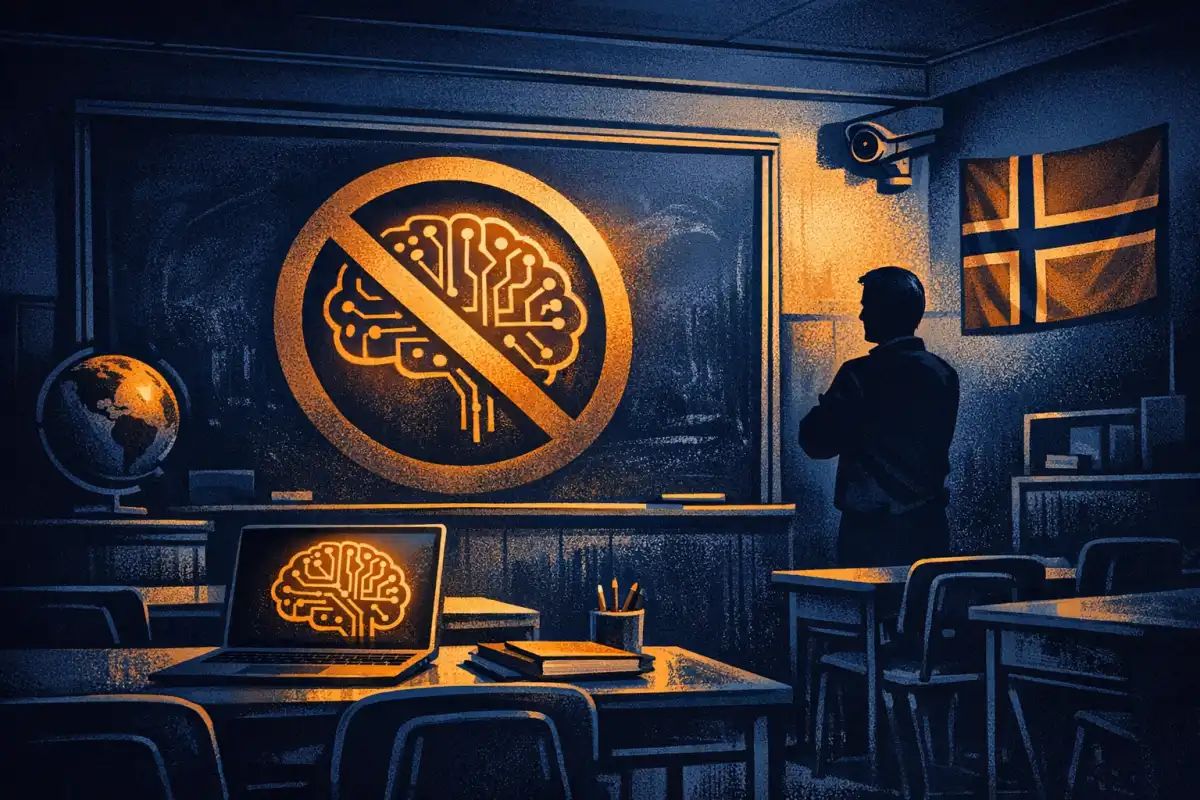
When was the last time a government actually paused to think through what AI in classrooms means for kids? Not a task force. Not a "we encourage responsible innovation" press release. Actual, binding rules with age thresholds and supervision requirements.
Norway just did that. And every other country should be paying attention.
What Norway Actually Did
In June 2026, the Norwegian government announced restrictions on AI use in schools that go into effect August 2026. The rules, as reported by Reuters, break down by age group:
- Ages 6-13 (grades 1-7): AI use should generally not happen. Effectively a ban for elementary school students.
- Ages 14-16 (lower secondary): Cautious adoption allowed, but only under direct teacher supervision.
- Ages 17-19 (upper secondary): Students should learn to use AI appropriately to prepare for higher education and work.
This is not a blanket ban. It is a graduated, age-appropriate framework. And that is exactly what makes it interesting.
Why This Matters More Than You Think
Most countries have taken one of two approaches to AI in education. The first is panic: ban ChatGPT entirely, block it on school networks, treat it as a cheating machine. The second is obliviousness: let teachers figure it out, maybe release a "guidance document" full of vague principles, and hope for the best.
Neither works.
The panic approach fails because students have smartphones. They have ChatGPT at home. They have AI built into search engines and word processors now. Blocking it at school does not stop them from using it. It just stops them from learning to use it critically.
The obliviousness approach fails because handing a 12-year-old an LLM with no structure is genuinely risky. We are talking about systems that hallucinate confidently, that can produce persuasive misinformation, that can do the thinking for students who need to develop that thinking themselves.
Norway found a third path. Treat AI like driving. You do not let a 10-year-old drive. You let a 15-year-old drive with supervision and limits. You let an 18-year-old drive independently because they have been trained.
The Developmental Case
There is real science behind age-based AI restrictions, even if Norway's policy was driven more by common sense than by peer-reviewed studies.
Children ages 6-13 are in what developmental psychologists call the concrete operational stage. They are learning to distinguish fact from fiction, to reason logically about the world in front of them. Introducing an AI that confidently states false information as fact, that generates text the child cannot evaluate critically, undermines the very skill they are trying to develop.
A 14-year-old has entered formal operational thinking. They can reason abstractly. They can question sources. With a teacher guiding the interaction, AI can become a tool for developing critical thinking rather than replacing it.
By 17, students should absolutely be learning to use AI tools. The workforce they are entering will demand it. But by that point, they have the cognitive foundations to use AI as a tool rather than being used by it.
What the Rest of the World Is Doing Wrong
The United States has no federal policy on AI in K-12 education. Individual school districts are making decisions, which means the quality of those decisions depends entirely on local resources and expertise. Wealthy districts hire consultants. Poor districts either ban everything or do nothing.
The EU AI Act addresses education as a high-risk sector, but the focus is on AI systems used for assessment and admissions, not on students using ChatGPT to write essays. There is no equivalent of Norway's age-graduated approach.
The UK published guidance in 2024 encouraging schools to "embrace AI" while being "mindful of risks." This is the policy equivalent of a shrug.
China has integrated AI into its curriculum aggressively, but the focus is on teaching AI concepts (coding, machine learning fundamentals) rather than on students using LLMs as writing tools. That is a different conversation.
Norway's approach works because it is specific. It draws lines. It says: this age group should not use this technology, this age group should use it under supervision, and this age group should learn it for the real world. You can agree or disagree with where the lines are drawn, but at least lines exist.
The Pushback You Should Expect
Technology companies will hate this policy. OpenAI, Google, and Anthropic all want students using their tools as early as possible. The reasoning is obvious: get them young, build habit formation, create a generation that cannot imagine working without your product.
Expect op-eds from industry-funded think tanks arguing that Norway is "holding its students back" or "falling behind in AI literacy." These arguments will be presented as concern for children's futures. They are concern for market share.
There is also a legitimate libertarian argument that parents, not governments, should decide when their children use AI. This argument has merit for home use. But schools are government institutions. The government deciding what tools are appropriate in its own classrooms, at what ages, is not overreach. It is curriculum design.
What Other Countries Should Learn
You do not need to copy Norway's exact age thresholds. You do need to copy the approach.
Be specific. "Use AI responsibly" is not a policy. "Students under 13 should not use LLMs during instruction, students 14-16 may use them with teacher supervision, students 17+ should learn to use them as professional tools" is a policy. It is enforceable. It gives teachers clarity.
Treat AI like any other powerful tool. Schools already restrict calculator use during math tests, internet access during exams, and driving on school grounds to students with licenses. AI is not categorically different. It is a cognitive tool that requires maturity to use well.
Focus on teacher training. Norway's policy works only if teachers understand AI well enough to supervise its use. Most teachers do not. Any AI-in-education policy must include substantial funding for teacher AI literacy. Without that, the supervision requirement becomes theater.
Watch what happens. Norway's policy goes into effect in August 2026. Researchers should be studying outcomes from day one. Does AI restriction at young ages improve critical thinking skills? Does supervised use at 14-16 produce better AI literacy than unsupervised use? The data from Norway could inform policy worldwide.
The Bigger Picture
Norway has a population of 5.5 million. Its education policy decisions do not usually make international headlines. But this one should, because it forces a conversation that every country is avoiding.
We handed children the most powerful information tool in human history and, in most places, did not bother to set any rules about when and how they should use it. We let schools figure it out. We let tech companies set the terms. We treated "AI literacy" as a buzzword rather than a curriculum.
Norway looked at that situation and said: no. Not in our schools. Not at this age. Not without supervision.
That kind of clear thinking is rare in AI policy. It should be contagious.
---
Norway's restrictions take effect August 2026. If your country has a better AI-in-education policy, we would love to hear about it. Most do not.
How Visible Is Your Brand to AI?
88% of brands are invisible to ChatGPT, Perplexity, and Gemini. Find out where you stand in 60 seconds.
Check Your AI Visibility Score Free