Alexa Plus Launches Conversational Food Ordering: Voice Commerce's iPhone Moment
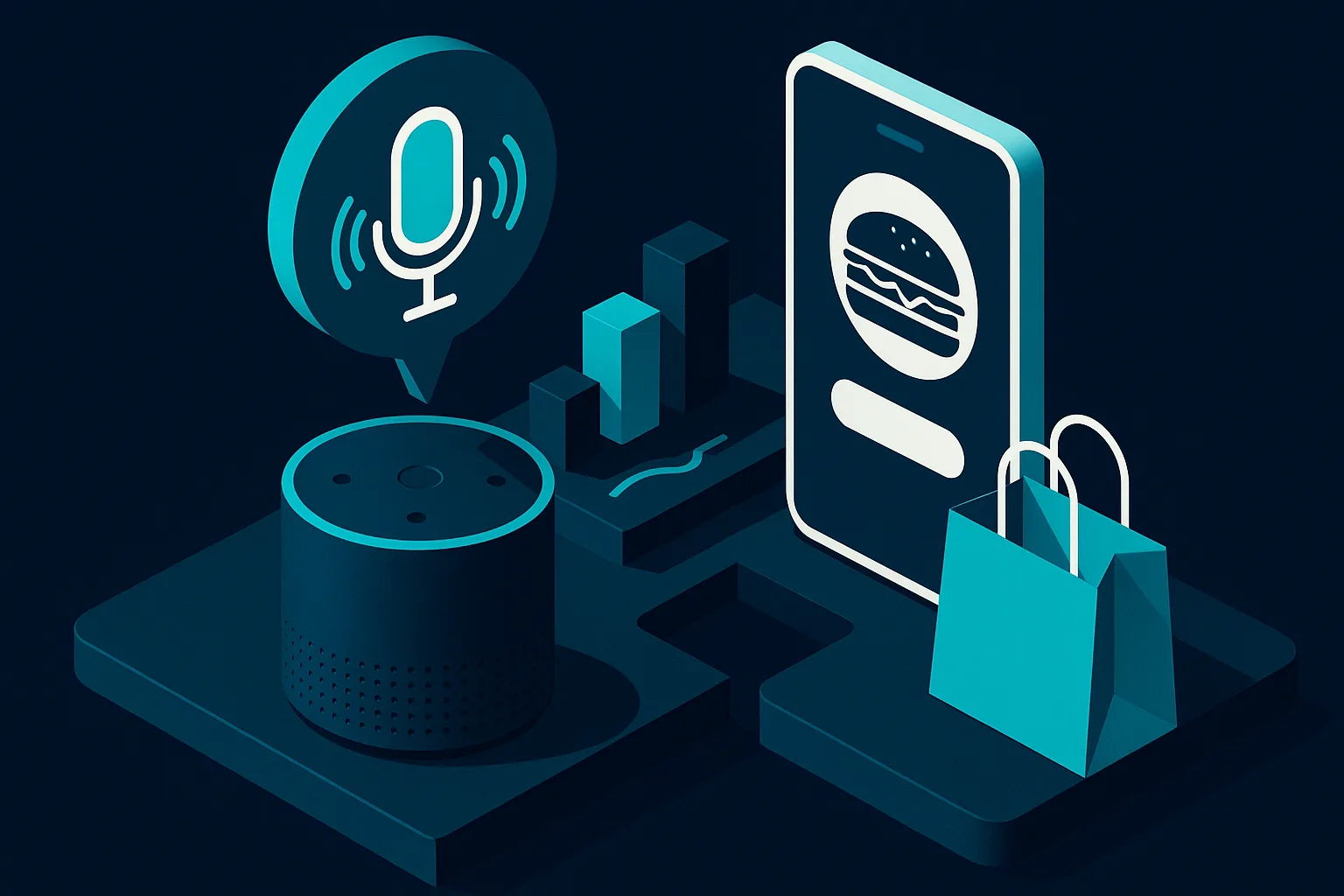
Amazon launched conversational food ordering through Alexa Plus on April 1, 2026, letting users order from Grubhub and Uber Eats through natural dialogue instead of rigid voice commands. The update transforms Alexa from a command-response tool into a commerce conversationalist, and Amazon confirmed grocery shopping and travel planning are next.
For years, voice commerce has been the "next big thing" that never quite arrived. The problem was never the technology. It was the experience. Ordering food through the old Alexa meant reciting menu items in specific syntax, confirming every single item, and enduring a painfully robotic exchange that made grabbing your phone seem infinitely faster.
That era just ended.
What Actually Changed
The new Alexa Plus food ordering experience works fundamentally differently from previous voice commerce implementations. Here's what Amazon built:
Natural conversation flow. You don't wait for Alexa to finish talking before changing your order. You can interrupt mid-sentence to say "actually, add fries to that" or "no, make it a large." The system handles mid-conversation modifications the way a waiter does.
Visual confirmation on Echo Show. For users with Echo Show 8 or larger devices, a conversational window displays your building order in real time. You see items added, prices updated, and modifications reflected instantly. This solves the "did Alexa get that right?" anxiety that killed previous voice ordering.
Contextual recommendations. You can ask Alexa to "show me desserts" from a restaurant, request "kid-friendly suggestions," or browse by cuisine type. The system understands context, so "show me something Italian near me" works without specifying a platform.
Account integration. Connecting your Grubhub or Uber Eats account syncs saved restaurants and past orders. "Reorder my usual from Panda Express" works immediately. This is critical because it eliminates the cold-start problem that made voice ordering impractical.
Proactive updates. After ordering, the "For You" section tracks delivery status, or you simply ask "where's my food?"
Amazon's VP of Alexa stated this is "just the start of our long-term vision for how customers can interact with Alexa," confirming grocery shopping and travel planning as upcoming capabilities.
Why This Time Is Different
Voice commerce has failed to gain meaningful traction since Amazon first introduced Alexa shopping in 2016. Three structural problems held it back, and this update addresses all three.
Problem 1: Command-and-response was too rigid.
Old voice commerce required users to know exact product names and follow specific conversational patterns. The new conversational model lets users browse, explore, and decide naturally. "What's good around here?" is now a valid starting point for a $50 food order.
Problem 2: No visual confirmation created trust gaps.
When you order food, you want to see your cart. The Echo Show integration provides this. It's not purely voice anymore; it's voice-primary with visual confirmation. This hybrid model mirrors how humans actually make purchase decisions: discuss options verbally, confirm visually.
Problem 3: Account setup was too painful.
Previous integrations required complex linking processes. The new system uses a simple OAuth flow through the Alexa app: More > Alexa+ Store > Food & Reservations. Two taps and your Grubhub account is connected.
The Voice Commerce Market in 2026
The market for voice-enabled commerce is reaching critical mass. Key metrics:
- 8.4 billion voice assistant devices globally in 2026, according to WCBooster research
- 20-50% of searches in many contexts are now voice-initiated
- Voice commerce market projected to reach $258 billion by 2028
- Google Search Live expanded to 200+ countries on March 26, enabling voice and camera search powered by Gemini 3.1 Flash Live
- Meesho's Vaani voice commerce platform serves 500 million users in India who prefer voice over text
The convergence of Alexa Plus, Google Search Live, and emerging platforms like Meesho Vaani creates a three-front voice commerce expansion: developed markets (Amazon, Google), emerging markets (Meesho), and enterprise (Oracle AI agents with voice interfaces).

What This Means for Restaurants and Food Delivery
If you operate a restaurant or food delivery brand, the Alexa Plus update creates immediate optimization imperatives:
Menu structure matters more than ever. When a user says "show me something healthy under $15," Alexa needs structured menu data to respond. Restaurants with clean, categorized, priced menu items in Grubhub/Uber Eats will surface first. Restaurants with messy, uncategorized menus won't appear in conversational results.
Reviews drive voice recommendations. When Alexa recommends restaurants, it pulls from ratings and reviews. A restaurant with 4.7 stars and 2,000 reviews will be recommended over a competitor with 4.2 stars and 200 reviews. The voice interface amplifies the winner-take-most dynamics already present in food delivery platforms.
"Re-order" becomes the dominant pattern. Amazon specifically highlighted past order syncing. This means the first transaction matters enormously. If a customer's first voice order goes well, "reorder my usual from [your restaurant]" becomes a frictionless repeat purchase channel. If it goes poorly, you're erased from their voice ordering vocabulary.
Cuisine keywords become voice keywords. Users don't search for restaurant names in voice. They say "Italian," "sushi," "burgers," or "Thai food." Making sure your restaurant's cuisine classification is accurate and specific in platform listings becomes critical for voice discovery.
The Bigger Play: Voice as the Default Commerce Interface
Amazon's announcement explicitly states that grocery shopping and travel planning are next. This signals a roadmap where Alexa Plus becomes the primary commerce interface for:
Recurring purchases. "Alexa, reorder my groceries" for weekly staples. This is Amazon's ultimate play: converting voice into the default channel for high-frequency, low-consideration purchases where convenience beats price comparison.
Service bookings. "Alexa, book a plumber for Saturday morning." This extends voice commerce beyond physical products into the $5.4 trillion US services market.
Travel transactions. "Alexa, find me flights to Barcelona for the second week of June." Travel booking through conversation has massive potential because it's an inherently consultative purchase. "What about hotels near the beach?" is a natural follow-up that works perfectly in conversational voice.
The competitive landscape is shifting rapidly. Google Search Live now enables voice and camera search globally, powered by Gemini 3.1 Flash Live. Apple is rebuilding Siri with LLM capabilities. Meta is integrating Manus (its $2-3 billion AI agent acquisition) into Instagram and WhatsApp.
How Brands Should Prepare for Voice Commerce
The transition from text search to voice commerce requires different optimization strategies:
Optimize for conversational queries, not keywords. Voice users don't say "best Italian restaurant downtown open now." They say "what's a good Italian place near me that's still open?" Your content, listings, and structured data need to match natural speech patterns.
Build voice-ready product data. Every product needs a spoken description that makes sense when read aloud. "12-ounce organic cold-pressed green juice with spinach, kale, and apple" is voice-ready. "GRN JCE 12OZ ORG" is not.
Prioritize the "consideration set" position. In voice commerce, there's no page 2. Alexa recommends 2-3 options, not 20 blue links. Being in the top 3 for your category is the difference between voice sales and voice invisibility.
Invest in reviews and ratings. Voice assistants use social proof as a primary ranking signal. A systematic review generation strategy is no longer optional; it's the cost of entry for voice commerce.
Create "reorder" hooks. Design the first purchase experience to be exceptional so customers default to voice reordering. Include a handwritten note, a small bonus item, or perfect packaging. The voice reorder loop is the most valuable customer retention mechanism in commerce.
What the Competition Is Doing
Amazon isn't operating in a vacuum:
- Google Search Live expanded to 200+ countries on March 26, enabling real-time voice and camera conversations with Search, powered by Gemini 3.1 Flash Live. Users can point their camera at a restaurant and ask about the menu.
- Apple is rebuilding Siri as a conversational AI assistant capable of multi-turn interactions and app integrations.
- Home Assistant Voice is emerging as a self-hosted, privacy-first alternative with natural language understanding for users who don't want their voice data in corporate clouds.
- Meesho Vaani in India serves 500 million users with voice-first commerce in local languages, proving voice commerce scales in markets where text literacy is a barrier.
The voice commerce landscape in 2026 is no longer a single-platform game. Brands need cross-platform voice optimization strategies that work across Alexa, Google, Siri, and emerging players.
The Bottom Line
Amazon's Alexa Plus conversational food ordering isn't just a feature update. It's the first credible proof that voice commerce can work at scale when the conversational experience is natural, the visual confirmation reduces errors, and the account integration eliminates friction.
With grocery shopping and travel planning confirmed as next, and 8.4 billion voice devices installed globally, voice is transitioning from a novelty to a primary commerce channel. Brands that optimize now will own the voice commerce wave. Brands that wait will discover there's no "page 2" in a voice assistant's recommendation.
---
Is your brand visible when AI assistants recommend products? Run a free audit at audit.searchless.ai to check your visibility across ChatGPT, Perplexity, Gemini, and voice assistants.
{{< cta-whitelabel >}}
{{< cta-audit >}}
FAQ
How do I set up Alexa Plus food ordering?
Connect your Grubhub or Uber Eats account through the Alexa app by selecting More > Alexa+ Store > Food & Reservations. Your saved restaurants and past orders will automatically sync. You'll need an Echo Show 8 or larger for the visual interface.
Does Alexa Plus food ordering work on all Echo devices?
The full conversational ordering experience with visual display is available on Echo Show 8 and larger devices. Amazon has not yet confirmed whether voice-only ordering (without visual confirmation) will be available on standard Echo speakers.
How big is the voice commerce market in 2026?
The voice commerce market is projected to reach $258 billion by 2028, with 8.4 billion voice assistant devices installed globally in 2026. Voice-initiated searches account for 20-50% of all searches in many contexts.
What's coming next for Alexa Plus commerce?
Amazon confirmed that grocery shopping and travel planning are the next commerce capabilities for Alexa Plus, building on the conversational ordering model introduced with food delivery.
How should restaurants optimize for voice ordering?
Focus on clean, categorized menu data in delivery platforms, maintain high ratings (4.5+ stars), ensure accurate cuisine classification, and prioritize the first-order experience to drive repeat voice reorders.
How Visible Is Your Brand to AI?
88% of brands are invisible to ChatGPT, Perplexity, and Gemini. Find out where you stand in 60 seconds.
Check Your AI Visibility Score Free